Show Me Your Steps
A little crab asks for an example before a lesson.
Free to read · Ten illustrated pages · No account required
Story note for grown-ups
An original child-friendly adaptation of an Aesop fable. Read together and discuss the choices rather than treating animal behaviour as a rule about people.
Page 1
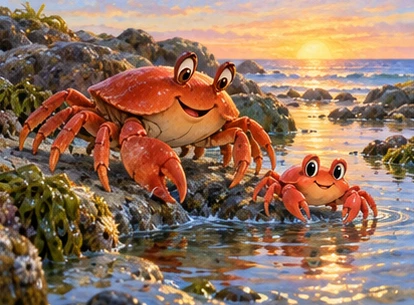
A mother crab and her little child emerged from a tide pool at dawn. The beach was quiet, and their sideways footsteps made tiny tracks in the smooth damp sand.
Jump to a page or discussion
Page 2
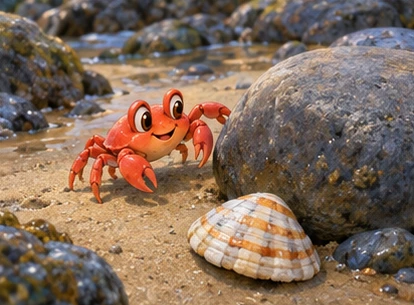
The little crab hurried around a pebble to inspect a shell. His mother watched him zigzag across the beach. She thought his sideways route looked rather untidy and slow.
Page 3
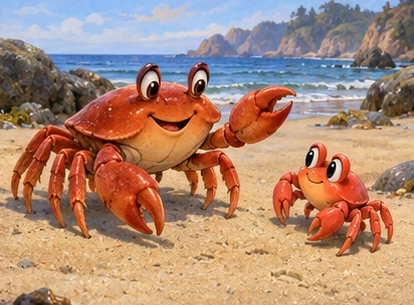
She asked him to walk straight forward instead. That would look neater, she said, and perhaps get them to the next pool sooner. The little crab stopped to listen.
Page 4
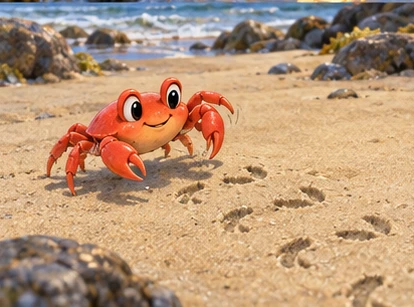
He looked at his legs, then at the path ahead. He tried to move forward exactly as she wanted, but his comfortable steps kept carrying him to the side.
Page 5
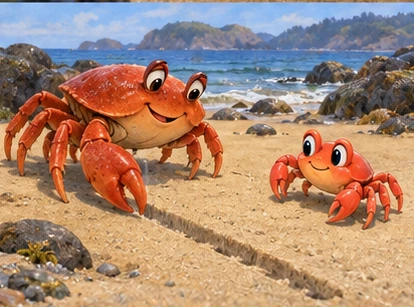
Could you show me first, he asked politely. Then I can follow your footprints. His mother agreed at once and lined herself up with a narrow groove in the sand.
Page 6
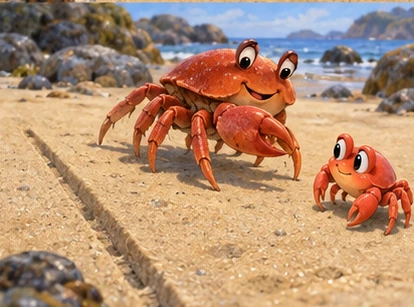
She lifted her legs carefully and tried a straight walk. Yet her own body moved sideways too. After a few steps, she found herself beside the groove instead of ahead.
Page 7
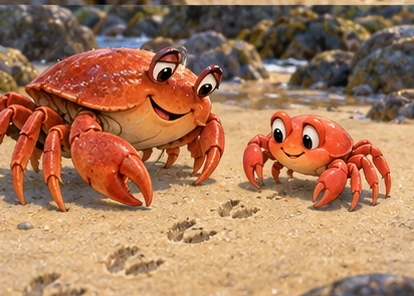
The mother stopped and looked at her tracks. She had asked for something she could not demonstrate herself. The little crab waited kindly, without laughing at her surprising discovery.
Page 8
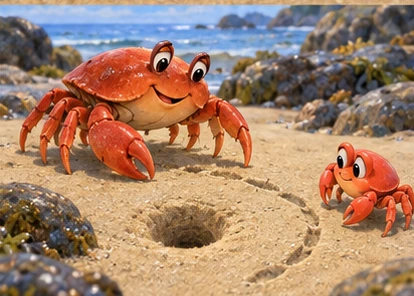
She admitted that sideways steps suited a crab very well. Instead of judging his route, she could teach him to watch the tide, avoid deep holes, and keep his claws clear.
Page 9
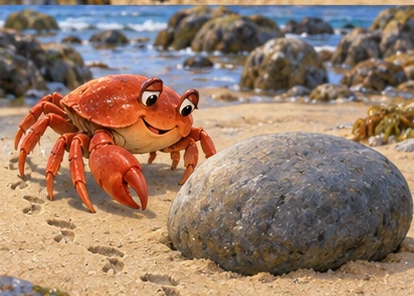
This time she showed each careful step before asking him to try. They went around a smooth stone together, leaving two tidy sets of sideways tracks beside the water.
Page 10
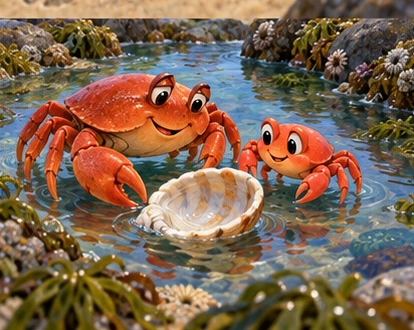
At the next tide pool, the little crab found a lovely empty shell. His mother smiled. A useful lesson began with an honest example and room for both of them to learn.
About this Neutoons edition
Expanded original bilingual retelling of the cited fable; dialogue and setting details are newly written.
Source tradition: Aesop. Based on “The Two Crabs” in The Fables of Aesop, selected and told anew by Joseph Jacobs (Macmillan, 1894). Explore the source.
Neutoons English and Hindi text. AI-generated illustrations. This edition has still illustrations. The ten-page edition has no audio narration.