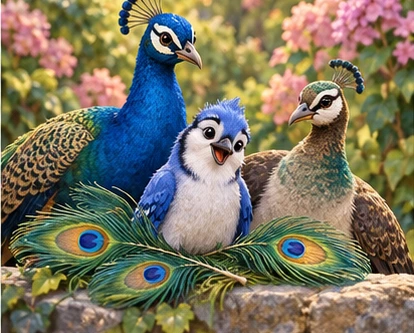
The Crow and the Pebbles
A thirsty crow discovers how small steps can solve a difficult problem.
Free to read · Ten illustrated pages · No account required
Story note for grown-ups
An original child-friendly adaptation of an Aesop fable. Read together and discuss the choices rather than treating animal behaviour as a rule about people.
Page 1

A little crow flew above a meadow on a very warm afternoon. The stream had shrunk to a silver thread, and every puddle beside it was dry.
Jump to a page or discussion
Page 2
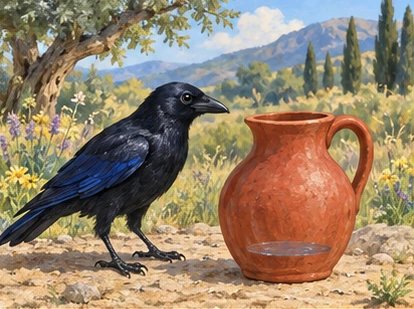
Beyond a garden gate, the crow noticed a red clay pitcher. He landed beside it and peered inside. A little water shone at the very bottom.
Page 3
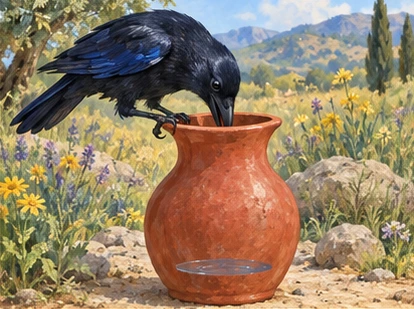
He stretched his neck through the opening, but his beak could not reach the water. He tilted his head and tried again, carefully keeping both feet balanced.
Page 4
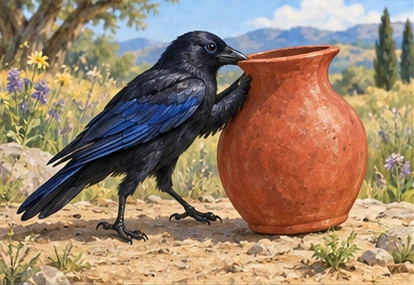
Perhaps the pitcher could be tipped over. The crow pushed its rounded side, first gently, then firmly. It stayed upright, too heavy for such a small bird.
Page 5
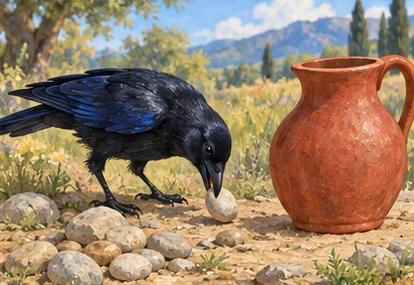
The crow stepped back into the shade to think. Near his feet lay smooth little pebbles. He picked up one and looked from it to the pitcher.
Page 6
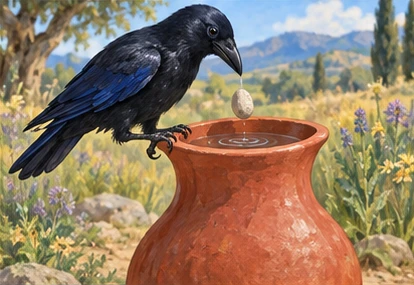
Plip! The pebble fell into the water. The crow watched the tiny ripple settle. Was the water a little higher now? He fetched another pebble to find out.
Page 7
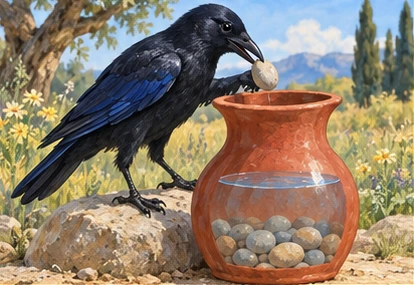
One pebble followed another. The crow carried only stones that fitted comfortably in his beak. Each one sank, and slowly the water rose above the growing pile.
Page 8
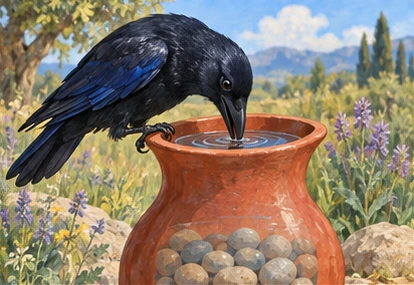
The sun moved across the garden wall while the crow kept working. At last, the bright surface was close enough. He rested one foot against the pitcher and leaned forward.
Page 9
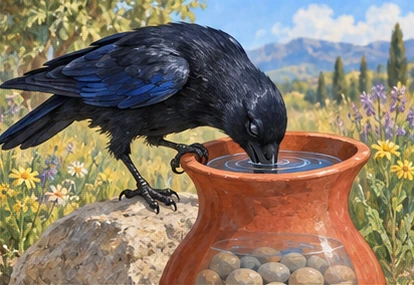
Cool water touched his beak. He drank, paused, and drank again. The pitcher had not become lighter, and his neck had not grown longer. His idea had changed the problem.
Page 10
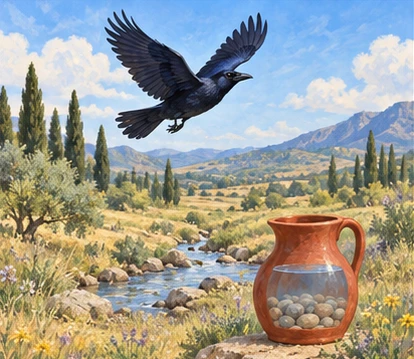
Refreshed, the crow flew back over the meadow. Below him, the small pebbles rested inside the pitcher. A difficult afternoon had become a lesson in patient, thoughtful work.
Story summary and moral
A thirsty crow finds water at the bottom of a heavy pitcher. His beak cannot reach it, and pushing does not tip the pitcher over. He drops in a pebble, notices the water rise and keeps adding pebbles until he can drink.
What can we take from this version?
Careful observation and patient small steps can help solve a problem. The crow changes his approach after pushing fails; he does not solve it merely by trying the same action harder.
Questions to talk about
- Which two approaches fail before the crow tries pebbles? Page 4
- What does the crow observe after the first pebble? Page 6
- At the end, what has changed: his neck, the pitcher’s weight or the water level? Page 9
A story activity
Draw three pitchers with low, middle and high water lines. Add drawn pebbles to show the order of events. Beneath them, finish the sentences “First he tried…”, “Then he noticed…” and “Finally…”. Use drawings rather than a real container of stones.
Printable worksheet and answers
About this Neutoons edition
Expanded original bilingual retelling of the cited fable; dialogue and setting details are newly written.
Source tradition: Aesop. Based on “The Crow and the Pitcher” in The Fables of Aesop, selected and told anew by Joseph Jacobs (Macmillan, 1894). Explore the source.
Neutoons English and Hindi text. AI-generated illustrations. This edition has still illustrations. The ten-page edition has no audio narration.