The Peacock and the Nightingale Song
A beautiful bird discovers that every talent need not belong to one person.
Free to read · Ten illustrated pages · No account required
Story note for grown-ups
An original child-friendly adaptation of an Aesop fable. Read together and discuss the choices rather than treating animal behaviour as a rule about people.
Page 1
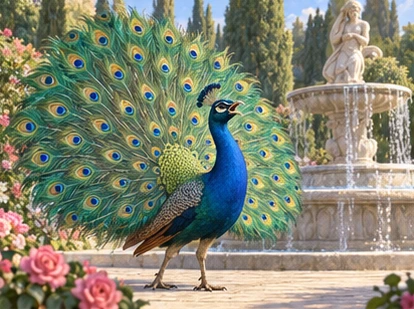
A peacock spread his magnificent tail in a flowering garden. Visitors stopped to admire the blue and green patterns. He enjoyed their smiles as he turned slowly beside the fountain.
Jump to a page or discussion
Page 2
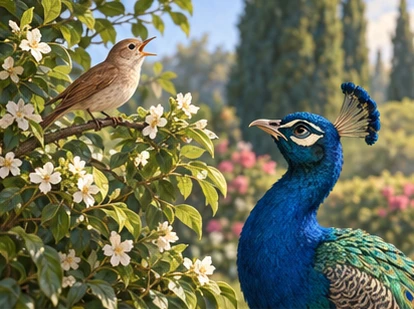
From a leafy bush came a nightingale's song. Its clear notes rose and fell like water over stones. The visitors listened quietly, and the peacock folded his tail to hear.
Page 3
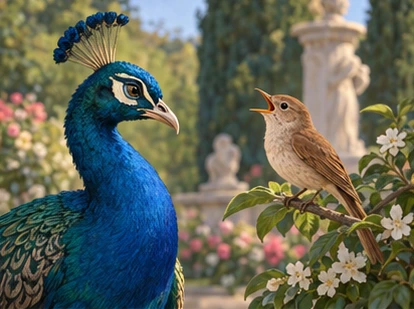
The little brown bird did not have a splendid fan or shining colours. Yet its voice filled the whole garden. The peacock began to wish he could sing that way too.
Page 4
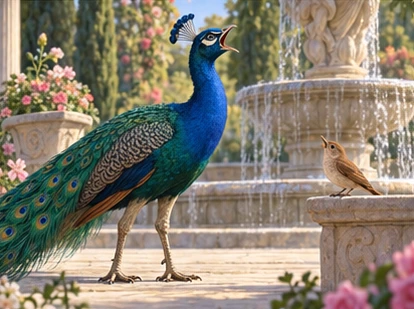
He tried a note of his own. His usual call sounded quite different from the nightingale's melody. He tried again, louder this time, but the sound remained a peacock's call.
Page 5
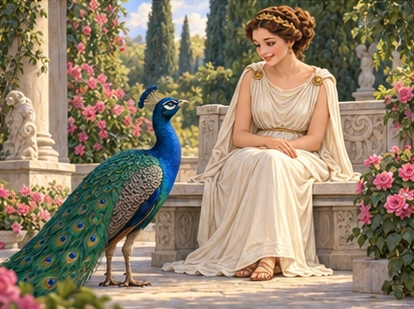
The peacock visited Juno, the wise figure of this old fable. She sat on a stone bench beneath flowers. He asked her for a nightingale's voice as well as his tail.
Page 6
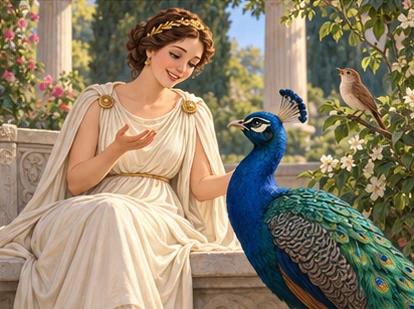
Juno listened while he explained his wish. He already had beautiful feathers, she reminded him. The nightingale had a beautiful song. Different gifts made the garden interesting for everyone.
Page 7
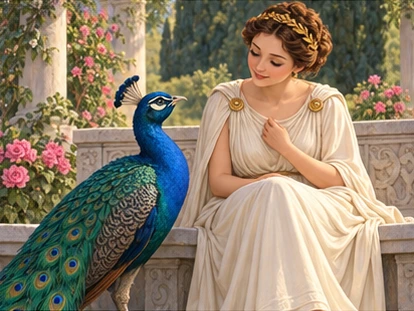
The peacock still felt a little disappointed. Juno did not tell him to stop learning. She simply asked whether admiring another's talent meant he had to possess it himself too.
Page 8
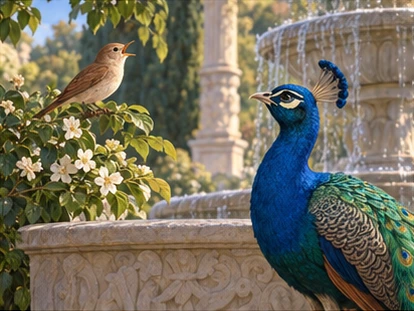
Returning to the fountain, he watched the nightingale sing again. This time he listened instead of competing. Its music was something he could enjoy without taking it away or replacing it.
Page 9
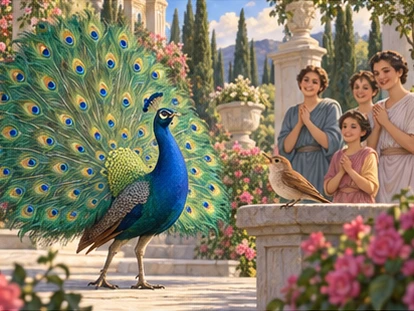
He opened his tail while the song drifted through the leaves. The visitors enjoyed colour and music together. Neither bird needed to do everything to make the afternoon feel special.
Page 10
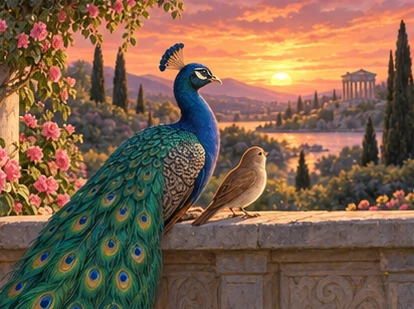
At sunset, the peacock thanked the little singer. He could keep discovering his own abilities and celebrate someone else's. The garden had room for more than one kind of beauty.
About this Neutoons edition
Preserves Juno and the peacock’s request for a nightingale voice; makes clear this is a classical fable and frames diverse gifts without discouraging learning.
Source tradition: Aesop. Based on “The Peacock and Juno” in The Fables of Aesop, selected and told anew by Joseph Jacobs (Macmillan, 1894). Explore the source.
Neutoons English and Hindi text. AI-generated illustrations. This edition has still illustrations. The ten-page edition has no audio narration.