The Fine Harness and the Farm Cart
A proud horse learns that a different job does not decide anyone’s worth.
Free to read · Ten illustrated pages · No account required
Story note for grown-ups
An original child-friendly adaptation of an Aesop fable. Read together and discuss the choices rather than treating animal behaviour as a rule about people.
Page 1
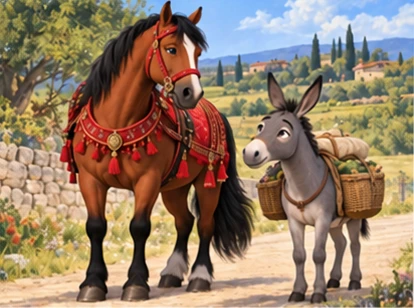
A chestnut horse travelled down a country road wearing a bright red harness. Nearby, a grey donkey carried baskets at a slower pace. The horse admired his own polished buckles.
Jump to a page or discussion
Page 2
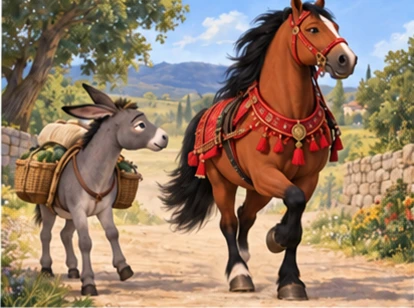
The donkey moved aside to make room on the narrow path. Instead of thanking him, the horse complained that ordinary working animals should stay out of the way of impressive ones.
Page 3
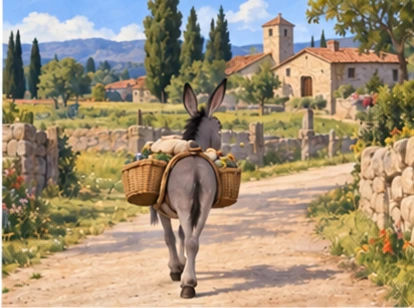
The donkey said nothing unkind in return. He continued steadily toward the farm. His baskets were useful, and arriving safely mattered more to him than arguing about whose harness looked brighter.
Page 4
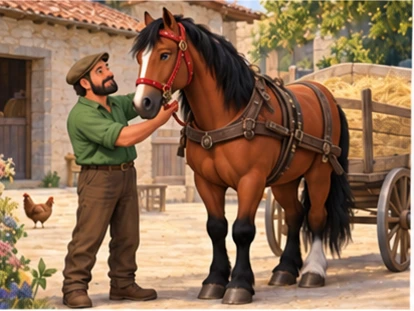
Some weeks later, the horse's owner changed his work. The long fast journeys were too tiring, so the horse came to the same farm to pull a light cart instead.
Page 5
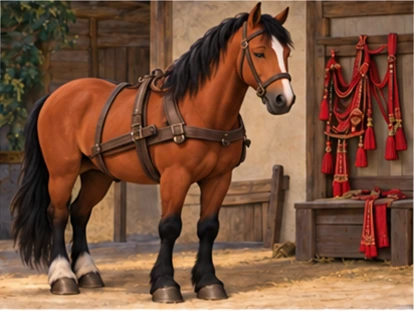
His red decorations stayed in the stable while he wore a plain, comfortable harness. The horse looked around the yard, uneasy. He wondered what the donkey would say about this change.
Page 6
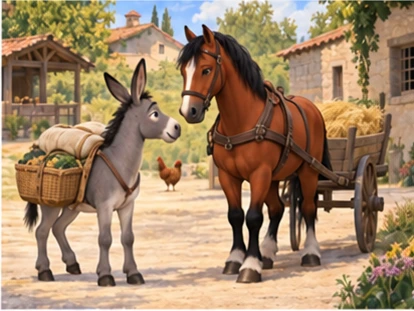
The donkey recognised him and paused beside the cart. He remembered the rude words on the highway. The horse lowered his head, understanding how unpleasant those words must have felt.
Page 7
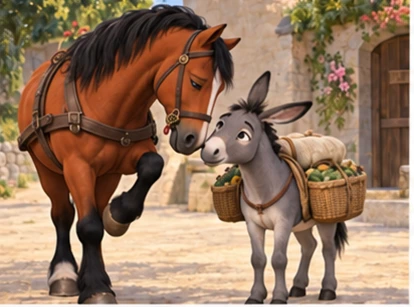
The horse apologised. His new task was different, but he was still the same animal. He could finally see that the donkey's quieter work had always deserved respect as well.
Page 8
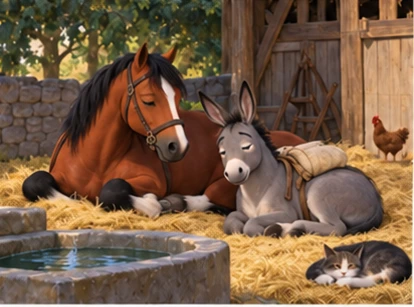
The donkey accepted the apology and showed him the shady resting place by the barn. They would both have water, food, and breaks. No bright buckle could replace those important things.
Page 9
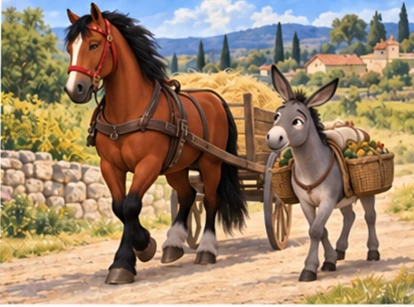
Soon the horse pulled the light cart at an easy pace while the donkey carried two small baskets. Each job helped the farm, and neither animal needed to boast over the other.
Page 10
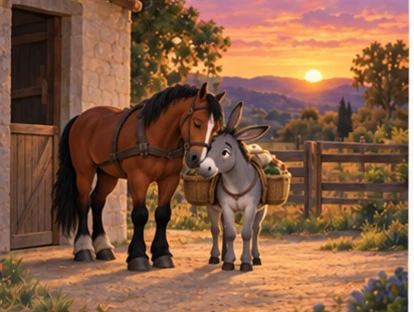
At sunset, they stood side by side near the stable. The horse's harness was plain, but his manners had improved. Respect belonged to the neighbour, not to the decorations they wore.
About this Neutoons edition
Uses Townsend’s proud horse sent to a farm (PG21), not Jacobs’s battlefield version. Replaces impaired breathing with tiring journeys and humane lighter work; threats and derision become apology and mutual respect.
Source tradition: Aesop. Based on “The Horse and the Ass” in Three hundred Aesop’s fables, translated by George Fyler Townsend, Project Gutenberg edition 21. Explore the source.
Neutoons English and Hindi text. AI-generated illustrations. This edition has still illustrations. The ten-page edition has no audio narration.